
· Dana Whitfield
Traveling With a Booster Seat: What Changes at Check-In and on Arrival
The trips where my kids flew with a booster rather than a harnessed seat were the easiest packing days I have had, and the ones where I nearly lost the gear. A booster is small, light and cheap to move, which is a gift right up until it is one loose object in a stack of suitcases. Here is what it actually changes: the cabin, check-in, how each shape packs, what the hold does to a small item, renting one where you land, and arrival. The three-option decision for a harnessed seat is in flying with a car seat.
What changes when you travel with a booster seat
| Harnessed car seat | Booster | |
|---|---|---|
| In the cabin | Possible on a purchased seat carrying the aircraft-certified label | Not usable as a restraint during taxi, take-off or landing |
| Where it rides | Cabin, gate check or counter check | Below, or as cabin baggage if it fits the size rules |
| Bulk | A boxy object with a headrest and a harness | The smallest child seat in the terminal |
| The airport carry | Wear it, or hand it over early | Light enough to wear the whole way without thinking about it |
| The real risk | Impact and snagged harness straps | Getting crushed, scuffed, or separated from you |
Almost every booster question is a baggage question. The one that is not is the cabin.
The cabin question, answered at the source
That sentence is from the FAA's Kids' Corner page on faa.gov, last updated in August 2026, and it governs U.S. aviation. Under another flag, that country's civil aviation authority writes its own rule, so check the one that covers your flight.
phases of flight where booster use is prohibited: ground movement, take-off, landing
— FAA Kids' Corner, 2026
The reason is mechanical rather than bureaucratic. The same page describes an approved child restraint system as a hard-backed child safety seat carrying the label "This restraint is certified for use in motor vehicles and aircraft", and tells you to read the manual to confirm it can be secured properly in an airplane seat, "otherwise, you may be asked to check the CRS as baggage." A booster is a different device: it positions a vehicle belt, and an aircraft belt is not the one it was drawn around. Your child flies in the aircraft seat belt, so nothing in your luggage has to solve the cabin.
Check-in and the gate when traveling with a booster seat
Everything after the cabin is logistics, and boosters are the easy end of it. On the major U.S. carriers a booster is child restraint equipment: free at the counter, free at the gate, outside your baggage allowance. The full policy picture is in do car seats fly free.
Which handoff point to use is where a booster differs from a convertible. Keeping a harnessed seat to the gate buys you a contained toddler during a delay. A booster buys you nothing there — a child who rides one walks, sits in the terminal seats, and does not need it before landing. So the counter is usually the answer: hand it over at bag drop and cross the airport hands-free. If you do keep it to the boarding door, the routine is in how to gate check a car seat.
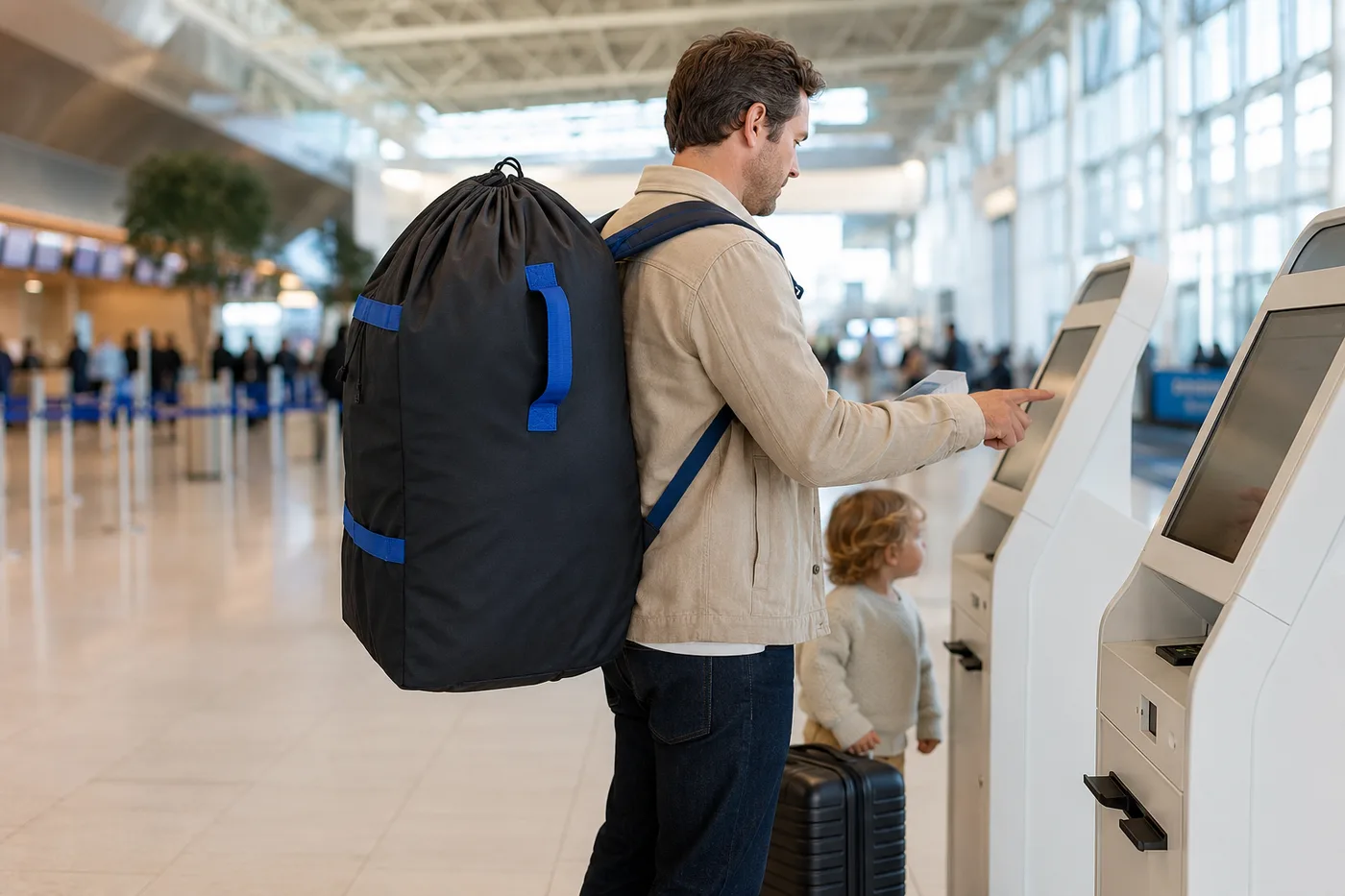
One phrase saves time at the counter: say "child restraint" rather than "booster seat", because the free category is written in restraint language. There is also a third route that exists only for boosters: a compact backless or folding model may fall inside the carry-on dimensions your carrier publishes. Read those before you count on the overhead bin, because a full bin settles it for you.
Backless, high-back, folding, inflatable: what the shape changes
Booster is a category, not an object, and the four shapes pack very differently. One rule covers all of them: what a model is certified to do, and where, is printed on its own label and written in its manual. That label answers whether it may be used in a given country or vehicle, and it travels with the seat.
| Shape | How it packs | What to watch |
|---|---|---|
| Backless | The flattest pack there is; leaves the most spare room in any bag | Armrests and belt guides are the parts that snap off |
| High-back | Many separate into backrest and base, which nest flat together | Reassembly at the other end, in a parking garage, with the manual |
| Folding | Built for exactly this trip; collapses to a fraction of its footprint | Hinges and catches are the parts under load in a stack |
| Inflatable | Deflates to almost nothing and often travels in hand baggage | Certification and inflation instructions are model-specific |
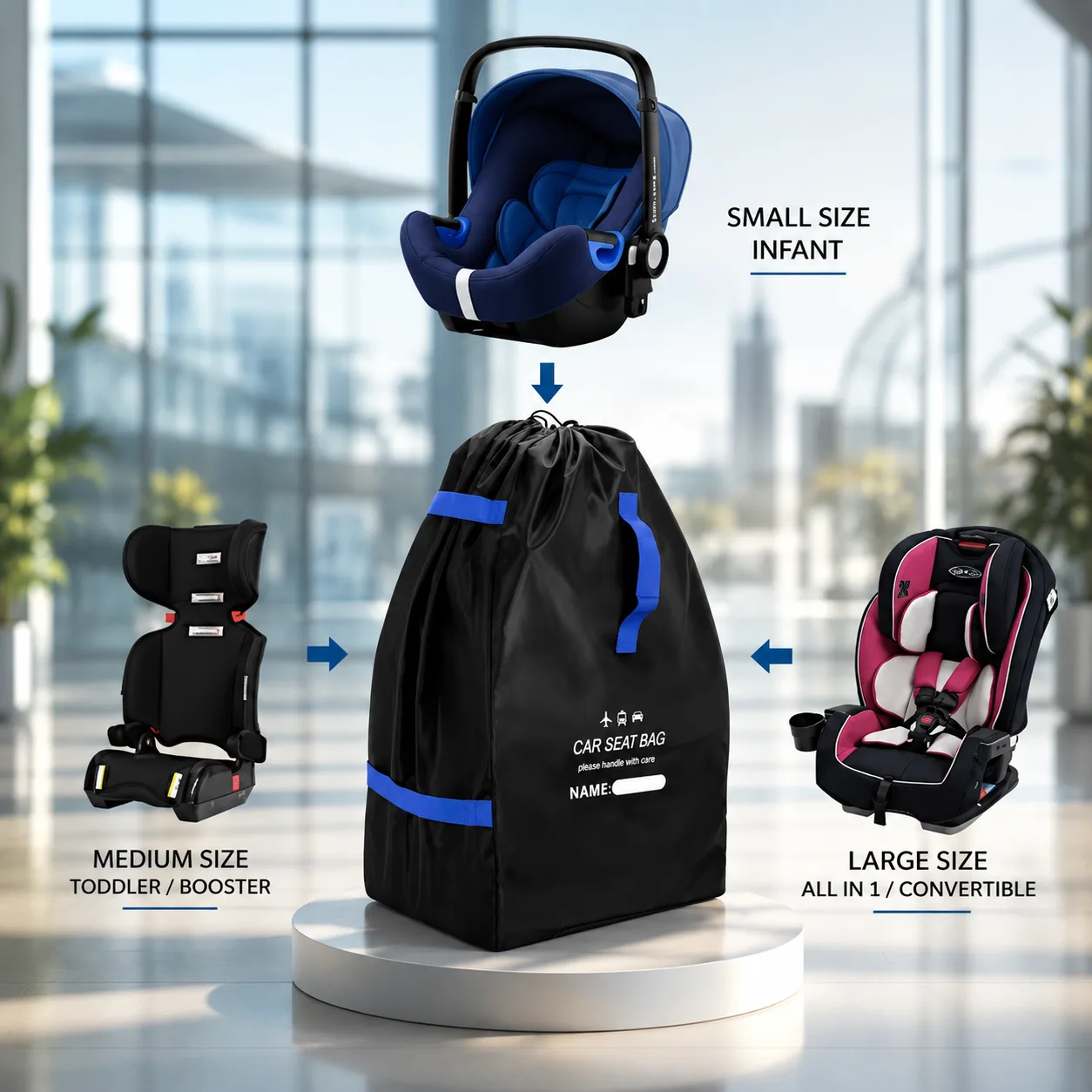
The high-back split is the one families discover late. Separating the backrest from the base turns an awkward L-shaped object into two flat panels that stack. Do it at home, not at bag drop with a queue behind you. The same trick runs through our seat fit guides, where boosters are the models that go in with room left over. That spare room is a problem to fill, not a bonus: a booster rattling inside a bag arrives wearing the scuffs of its own trip, and rolled clothes around the shell turn the volume into padding at no cost in luggage.
What the hold does to a small item
A booster is easy to move and easy to lose track of, and those are the same fact. Handlers load a stack of checked gear fast, and the objects that come through cleanly read as a single labeled liftable unit. A bare booster reads as none of them.
checked bags mishandled per 1,000 passengers worldwide
— SITA Baggage IT Insights, 2023
Four things happen to unbagged boosters specifically. They get wedged between hard cases, because they are exactly the size of a gap. Their fabric covers absorb whatever the tarmac cart has been sitting in. Their armrests and belt guides take the load when something heavy lands on top. And with no handle and no name on them, they are the item that gets set down and not picked up again.
All four are answered by putting the thing inside a bag with a name on it. Our car seat travel bag is 33 x 17 x 17 inches, sized for a full convertible, so a booster goes in with the most spare room of anything we pack. Water-resistant Oxford cloth keeps the tarmac off the fabric, a NAME window makes a black bag provably yours, and it folds into its own pouch for the week. What happens to seats down there is in do checked car seats get damaged.
What I put a booster in: the SeatPorter Car Seat Travel Bag — 33 x 17 x 17 inches (85 x 45 x 45 cm), water-resistant Oxford cloth, padded backpack straps, a NAME window, and a pouch it folds into when empty. Black with blue straps, $24.95. Two kids, or a stroller? The 2-Pack and the Complete Travel Set are both $44.95.
Renting a booster where you land
Adding a booster to a car rental is a line item away, so it comes up on every trip. What matters is what that reservation settles, and what it leaves open.
A rental booking adds a category to your order, not a specific model. The seat that appears is whichever the branch has that morning, and three things you would know about your own seat are not: which certification label it carries, whether its manual is with it, and what it has been through before you. A seat you did not own has a history you cannot read, and as the damage guide covers, the history of a child seat decides whether it still does its job. You can narrow the gap — confirm the model in writing, ask whether the manual comes with it, inspect the shell and the label before you drive off — but you cannot close it.
Bringing your own removes all three unknowns: you know the model, you have the manual, and you know where the seat has been. The trade is that it now has to travel, and that is a solved problem — a booster is the lightest thing you will ever check, and it costs one bag to do it properly.
The rule that applies is the one where you land
Here is the part I will not put a number on, deliberately. The thresholds that decide which restraint a child must use — by age, height, weight, or some combination — are set by the territory you are driving in. In the United States that means the state; abroad it means the country. They are not the same from one to the next, and a rule you know by heart at home has no authority four states or one border away.
So the pre-trip task is small and belongs next to passports on the list: look up the road safety authority for the state or country you are landing in and read what it requires. That authority, with the manual for your own seat, settles the question. If you are weighing whether your child should be in a booster at all rather than a harnessed seat, that decision belongs to your seat's manufacturer and to that authority, and I will not make it for you here.
Arrival: reclaim, inspect, and the ride out
Counter-checked, a booster comes back on the carousel. Gate-checked, it returns at the jet bridge or at baggage claim depending on the carrier and the airport, and asking a flight attendant before descent is the trick.
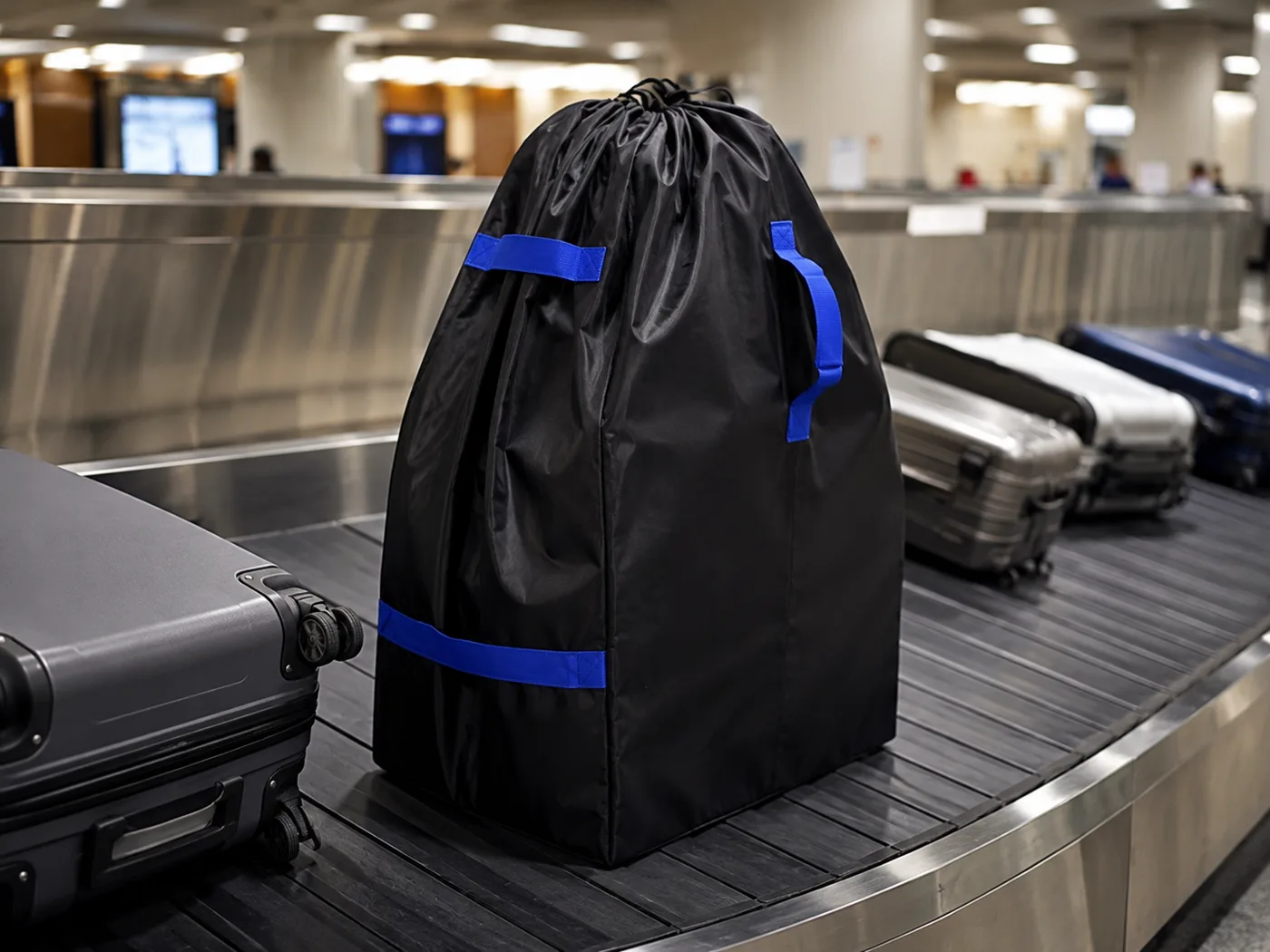
Do the inspection in the terminal, not in the parking garage. Unzip the bag and look at the shell, the armrests, the belt guides and any latching hardware. If a high-back separated for the flight, reassemble it there, where you still have light and a flat floor. If you find a crack, a deformation, or anything you did not put there, ask the seat's manufacturer what to do before your child rides in it again — that call is theirs — and report it before you leave the airport, which is what keeps a claim open.
Then the last stretch: rental car centers at the end of a shuttle, hotel pickups at the far curb, taxi ranks one escalator away — the walk our curb-to-gate guide describes, in reverse. A bagged booster rides your back with both hands free, and at the other end the bag folds into its pouch for the week.
Traveling with a booster seat: questions, answered
Can my child sit on a booster seat during the flight?
No. The FAA's Kids' Corner page states that it prohibits passengers from using baby carriers, booster seats, or backless child restraint systems during ground movement, take-off, or landing. That is the rule for U.S. aviation; elsewhere the country's own civil aviation authority decides. The booster travels below, or as cabin baggage if it fits the size rules.
Does a booster seat check free like a car seat?
On the major U.S. carriers a booster is handled as child restraint equipment and goes free at the counter or the gate. Policies live on carrier websites and change, so read yours the week you fly.
Can I bring a booster seat as carry-on baggage instead?
Sometimes. A compact backless or folding booster turns it into a plain baggage question: does it fit the carry-on dimensions your carrier publishes, and does it use your one bag or ride as an extra item? Both answers are on the carrier's baggage page.
How do I protect a booster in the hold when it is so small?
Bag it, name it, and fill the spare volume. A booster leaves more room inside a travel bag than any other child seat, so rolled clothes around the shell turn empty space into padding.
Flying with a stroller as well? The routine is in the stroller gate check guide, and the stroller travel bag is a separate one-size cut with green straps.

Dana Whitfield · Family Travel Writer
Mom of two, 60+ flights with car seats in tow.