
· Dana Whitfield
Do Checked Car Seats Get Damaged? Real Risks and How to File a Claim
This is the question parents ask me most at the gate, usually while holding a seat they paid two hundred dollars for and are about to hand to a stranger. Yes, seats get damaged. The damage is usually cosmetic, occasionally structural, and always easier to prevent than to be compensated for. Here is what happens down there, and what to do in the twenty minutes after you land.
What a checked car seat actually goes through
Your seat leaves your hands at the counter or the jet bridge and joins a system built for hard-sided suitcases: a belt, a sorting network of chutes and rollers, a cart across open tarmac in whatever weather the day offers, a belt loader, and a hold where the ramp crew stacks it wherever the load plan leaves room. On arrival the sequence runs backwards, usually ending on a carousel with everything else.
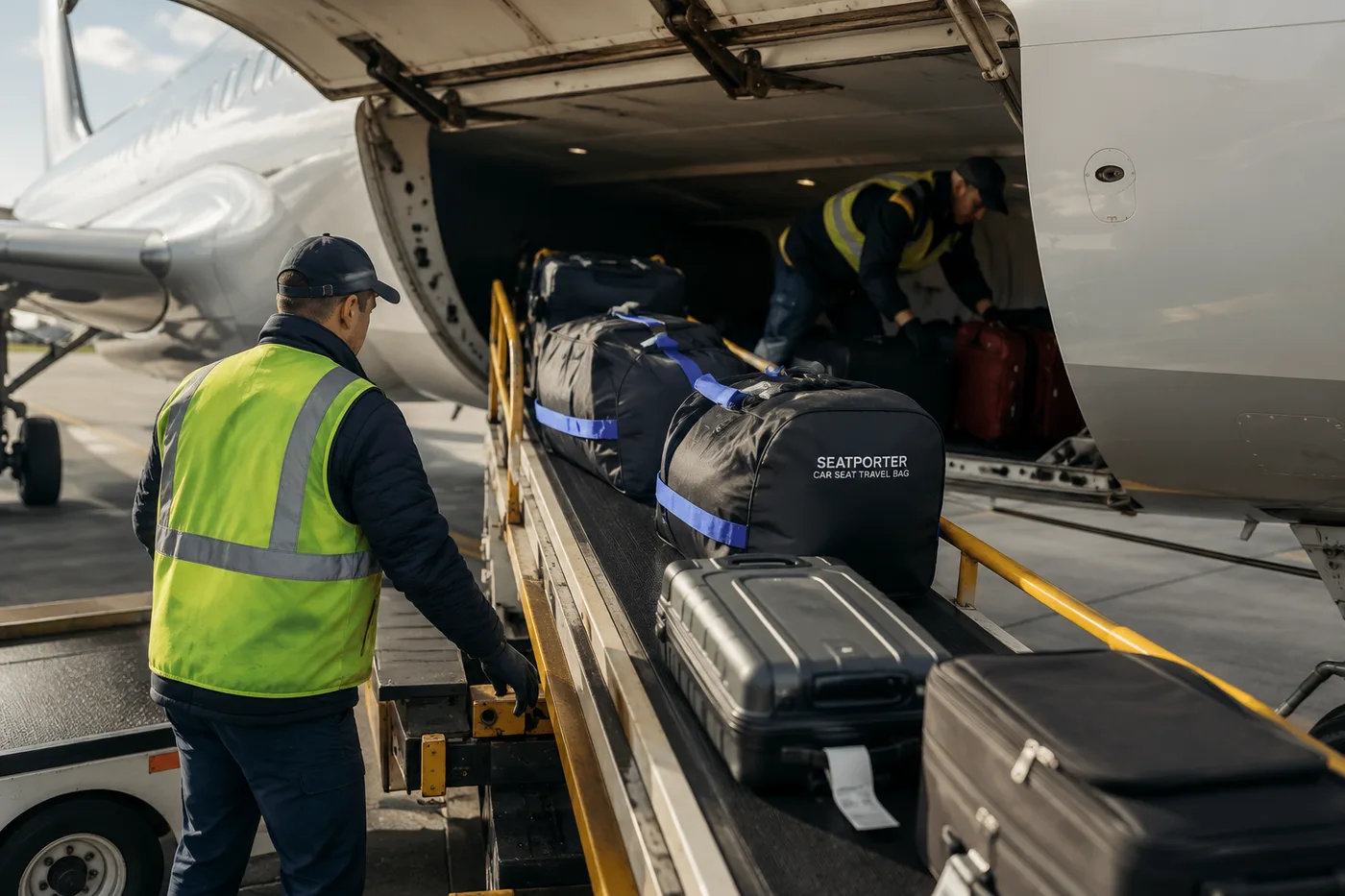
Four things about that ride matter for a car seat specifically. Compression: holds are packed to fill, so a seat near the bottom of a stack carries everything above it for the whole flight. Snagging: harness straps, chest clips and connectors are exactly the shape that catches on conveyor rollers, and a strap that catches while the belt keeps moving pulls hard on whatever it is stitched to. Moisture: covers and foam absorb rain, sleet and de-icing spray, then sit damp for hours. Impact: a rigid shell dropped onto a metal cart takes a hit no suitcase would register.
For scale, SITA's Baggage IT Insights counted 6.9 mishandled bags per 1,000 passengers in 2023 — and mishandled covers delayed, damaged and lost. That figure describes luggage engineered to be thrown. A car seat is engineered for one specific force, in one direction, once. None of this is malice from the carrier; it is what checking an item means, and it is why the routine in how to gate check a car seat starts with getting the seat inside something.
The five ways checked car seats get damaged
Sorted by how often I see them, and by what each one costs you.
| What happens | How it happens | What it costs you |
|---|---|---|
| Grease and grime on the cover | Cart beds, belt rollers, hold floors | Cosmetic, but it is the fabric your child sleeps against |
| Soaked fabric and foam | Open carts in rain, snow, de-icing spray | A seat nobody can sit in until it dries, on arrival day |
| Torn harness webbing or a bent buckle | Straps snagging on rollers and cart edges | Structural — the harness is the restraint |
| Snapped canopy, cup holder, or base clip | Loose parts crushed under stacked luggage | Parts orders, and sometimes an unusable base |
| Cracked or deformed shell | Compression under load, or a drop onto a hard edge | The whole seat, and this is the one you may not see |
The first two are annoyances. The last three are the seat's actual job, and they are not cosmetic events even when they look like nothing at all.
Why a crack you cannot see ends the seat's life
A car seat is a single-use energy structure. The shell and the foam are built to deform in a controlled way once, absorbing force so your child does not, and that design assumes the material starts intact. A fracture in the plastic, a compressed section of foam, or a stress line under the fabric changes how the structure behaves — and none of it is measurable by eye, because the parts doing the work sit behind the cover and inside the shell.
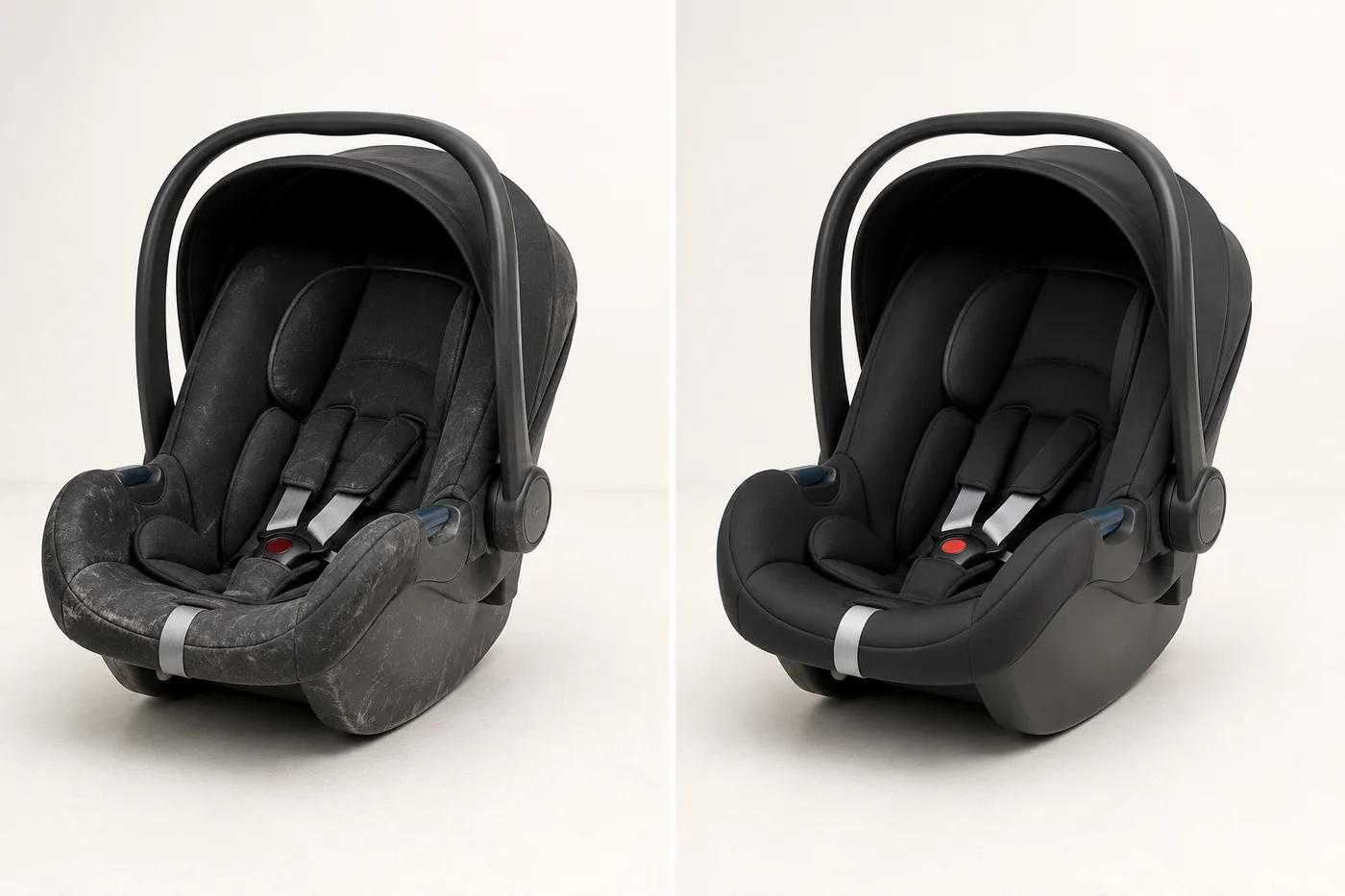
The safety framework already treats visible damage as decisive. In its car seat use after a crash guidance, NHTSA lists the conditions that together make a crash minor enough that a seat need not be replaced automatically, and one of them is that there is no visible damage to the car seat. The same guidance is unambiguous in the other direction: a seat involved in a moderate to severe crash must never be used again. (National Highway Traffic Safety Administration, 2026.)
That is crash guidance, not baggage guidance, and the distinction is real: a cargo hold is not a crash test, and nothing on the seat tells you how much load it carried. Which is why the call is not yours to make from the arrivals hall. If a seat comes off the belt with a crack, a deformed section, or a strap that has changed shape, stop using it and contact the manufacturer with the model name and the date of manufacture printed on the shell label. They are the only party who can rule on that seat. Until they do, it does not go back in a car — rent, borrow, or buy one at the destination, but do not gamble on a shell nobody has cleared. One more thing parents get wrong: warranties cover defects, not transport damage. A crack from the hold is between you and the carrier.
Inspect the seat before you leave the airport
This is the step that decides whether you have a claim or a story. Do it on the spot, next to the carousel or the jet bridge — not at the hotel.
Unbag the seat where you collect it and run four checks, about ninety seconds in all. Turn the shell over and look along the sides and base for cracks, stress whitening, and flat spots. Pull the harness out to full length on both sides, run it through your fingers for fraying, and click the buckle and chest clip. Press the foam through the cover along the sides and headrest, feeling for a section gone soft. Then check that everything that left home is still attached — base, canopy, inserts, cup holders.
Photograph as you go: the seat as it came off the belt, any damage in close-up, and your baggage tag with the number visible. Keep the bag it travelled in — its condition is part of the story.
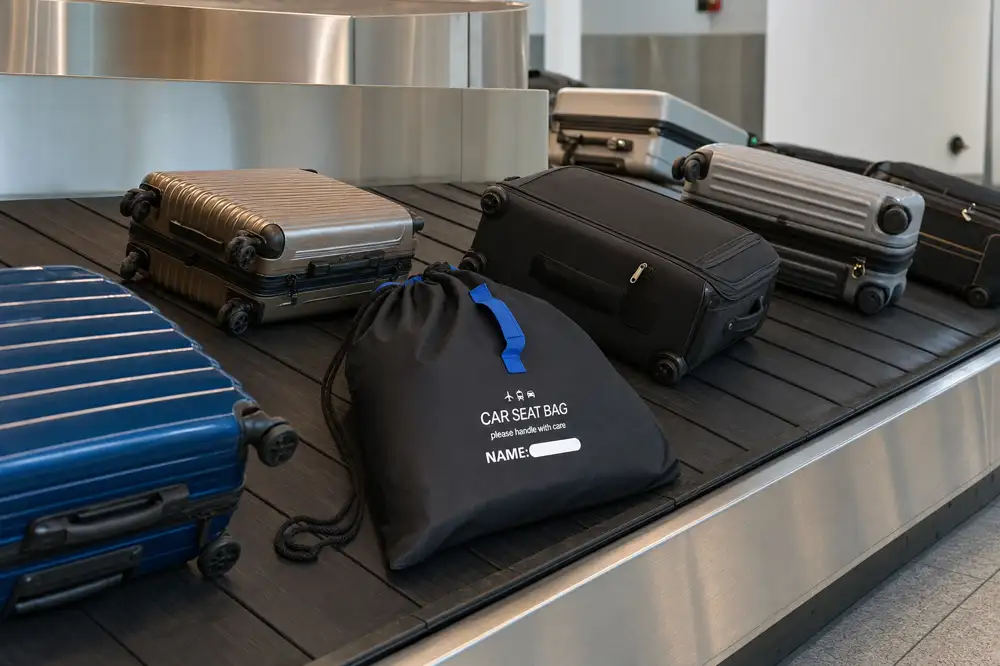
Why the terminal and not the hotel? Because of a line in the treaty that governs international carriage. The Montreal Convention of 1999 says in Article 31 that receiving checked baggage without complaint is prima facie evidence that it arrived in good condition. In plain terms: walking out with a damaged seat under your arm and saying nothing is not a neutral act. It is a fact the carrier can point to later, and you will spend the rest of the claim arguing your way back from it.
How to file a claim if your checked car seat gets damaged
The mechanics are the same almost everywhere. Work in this order.
- Report it before you leave the airport. The carrier's baggage service desk sits in the arrivals area, usually beside the carousels. Reporting in person creates the file reference every later step hangs on.
- Get the report number in writing. Not a verbal assurance: the reference number, the date, and the name or ID of the agent who took it. Photograph the paperwork.
- Put the complaint in writing too. Article 31 requires the complaint itself to be in writing, so send it through the carrier's damage claim form or baggage service email the same day, quoting your file number.
- Attach your evidence. Photographs of the damage, the baggage tag and receipt, boarding passes, and proof of what the seat cost — the purchase receipt, or the current listing for the exact model.
- Say what you are asking for. Repair, replacement, or reimbursement — and if the shell is cracked or the harness compromised, state that the seat has been retired on manufacturer and NHTSA guidance, so repair does not apply.
- Keep the seat. Do not throw it away, and do not let anyone else take it, until the file closes. The damaged item is the evidence, and carriers routinely ask to inspect it.
- Follow up in writing. Every contact by email or claim portal, every reference number quoted, nothing agreed by phone alone.
On the clock: for international carriage, Article 31 gives you seven days from the date you receive checked baggage to complain about damage, and states that where no complaint is made in time, no action lies against the carrier. A domestic itinerary is not governed by that treaty; the deadline comes from the carrier's contract of carriage, and can be shorter than you assume. Read the one that applies to your ticket the day you land.
What the carrier is actually on the hook for
Two things from the same treaty text are worth knowing before you write your first email. The first is when liability attaches. Article 17 makes the carrier liable for damage to checked baggage on the condition that the event causing it happened on board the aircraft, or during any period in which the baggage was in the carrier's charge. That window is wider than most people picture: it opens when you hand the seat over at the counter or the jet bridge, not when the doors close.
The second is the carve-out. The same article says the carrier is not liable to the extent that damage resulted from the inherent defect, quality or vice of the baggage itself. In airport terms, the condition an item is presented in is part of the conversation, and an unprotected seat with loose straps hanging off it invites exactly that argument.
You will not find a payout figure here. Liability ceilings are set in special drawing rights and revised periodically, domestic rules differ from international ones, and every carrier layers its own contract of carriage on top — plenty limit or exclude fragile and child-restraint items specifically. Anyone quoting a flat number is quoting one that expires. Read your carrier's baggage liability terms for the itinerary you booked, and note that a checked seat and a gate-checked seat can sit under different clauses on the same ticket. The fee side is covered in do car seats fly free?, and the three ways a seat can travel are in the complete guide to flying with a car seat.
The thirty seconds that keep you out of the claims line
Everything above is the recovery path. The prevention path is one step long.
What I put mine in: the SeatPorter Car Seat Travel Bag — water-resistant Oxford cloth that keeps cart grease and tarmac rain off the cover, a full zip that keeps harness straps, chest clip and connectors contained instead of dangling into the rollers, a NAME window for your contact card, and padded backpack straps so the seat rides on your back through the terminal. 33 x 17 x 17 inches, infant carriers through full convertibles, folds into its built-in pouch. Black with blue straps, $24.95.
Be precise about what a bag does, because the claims desk will be. Fabric stays clean and dry, straps and clips stay contained, loose parts stay with the seat, and your name stays attached. It also gives you what a bare seat cannot: one sealed item, photographed at handover and again at pickup — a claim built on evidence instead of memory. Sixty-plus flights in, I have filed exactly one damage report, and the seat inside the bag was fine.
Where to go next: the gate check bag, the bag comparison by travel pattern, and carrying a car seat through the airport for the walk from curb to gate.

Dana Whitfield · Family Travel Writer
Mom of two, 60+ flights with car seats in tow.