
· Dana Whitfield
How to Carry a Car Seat Through the Airport (Curb to Gate)
Sixty-some flights in, the hardest part of traveling with a car seat has never been the airline rules. It is the forty minutes between the drop-off curb and seat 24A, when an object the size of a laundry basket has to cross a building built entirely around wheeled suitcases. This guide is about that walk: who carries what, where wheels quit, what the checkpoint does to your plan, and when handing the seat over beats hauling it. The cabin-or-cargo decision is in flying with a car seat, and the boarding-door routine is in how to gate check a car seat.
How far do you actually carry a car seat in an airport?
Written out, it stops being one long haul and becomes four short ones with different rules.
| Leg | What the seat is doing | What catches people out |
|---|---|---|
| Curb or parking to check-in | In your arms, or on a rented cart | The cart bay is rarely near where you parked |
| Check-in to security | Your last chance to hand it over | Walking past the counter is a decision too |
| Security to the gate | The long leg, the one you cannot measure in advance | Gate changes, trams between concourses, escalators |
| Gate to the aircraft door | Bagged, tagged, about to change hands | A narrow jet bridge with a boarding queue behind you |
Only the last leg has a length you can predict. The rest depends on a gate number you get an hour ahead, in a terminal you may never have walked. Plan the carry for the worst version of that walk.
Decide how to carry a car seat through the airport before you leave the house
A concourse is a bad place to improvise a plan for a bulky object. Settle at home who wears the seat, who has the child and who has the roller. That allocation decides whether the walk is fine or miserable.
| Who is flying | Who takes the seat | Honest verdict |
|---|---|---|
| Two adults, one walking child | One wears it, the other takes the roller and the hand | Carry it all the way |
| Two adults, baby plus toddler | The adult not holding the baby | Workable, keep seat and roller on the same adult |
| One adult, one infant carrier | You, on your back | Fine, an infant seat is the light case |
| One adult, two children, a convertible | Nobody | Check it at the counter, buy yourself two free hands |
The hardware side of that choice, what padded straps do to the weight, is on our car seat backpack page. What matters here: whoever wears the seat should not also be holding a small hand. You will need that hand at the checkpoint, and again at the gate podium.
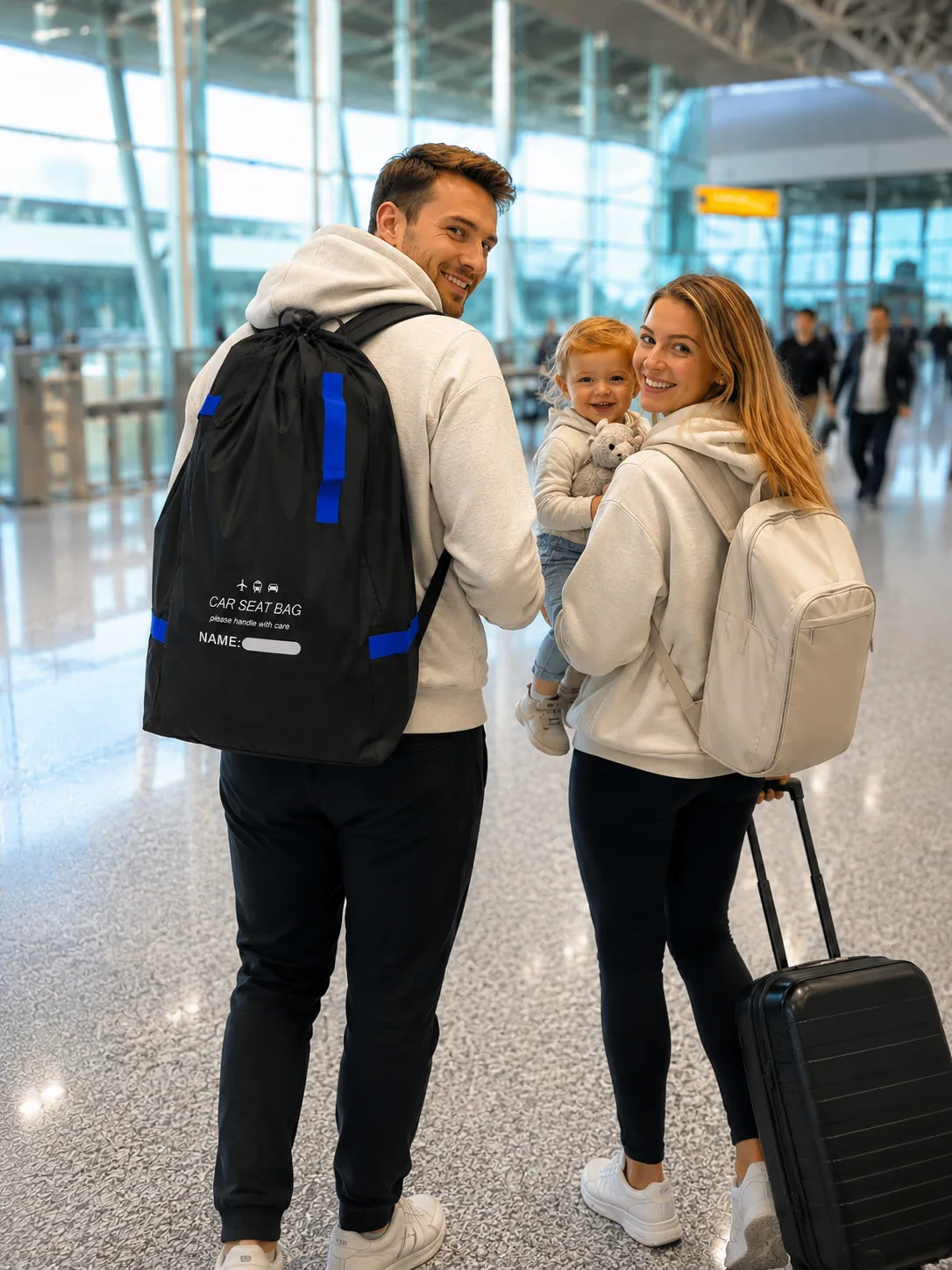
What rolls in an airport, and where the rolling stops
Luggage carts are the big one. Most large U.S. terminals rent them, many international airports hand them out free, and a car seat rides on one beautifully. Then you reach the checkpoint, where the cart stops and every plan that ended with grabbing a cart ends at the same X-ray machines, seat back in your arms.
Balancing the seat on the extended handle of a roller bag is the other classic. It works in a straight line for about the length of one gate. Then you turn, or you hit a floor seam, and you are catching a car seat with the arm that is towing the suitcase.
Two notes on airport floors. Escalators are unpleasant with anything held in front of you, so take the elevator and accept the wait. Moving walkways are the opposite: seat on your back, hand free, the closest thing to a break you will get. How backpack carry compares with a dedicated wheeled cart is worked through on the car seat backpack page, straps, bulk and all.
Carrying a car seat through the airport security checkpoint
Screening is the leg where the rules are not yours to write. TSA publishes guidance for travelers with children and the officer on duty applies it; outside the United States the local authority sets its own procedure.
My sequence: strip the cup holders and clip-on toys at home, walk up with the seat bare, lay it on its side so it does not roll, and send the folded bag through in a bin. An infant carrier and its base go as two items. Your child walks through the detector or you carry them.
Bagging the seat before security is the mistake I see most. An opaque black bundle earns a second look, and you are the one unzipping it on the belt. The bag has one job at the checkpoint: stay folded.
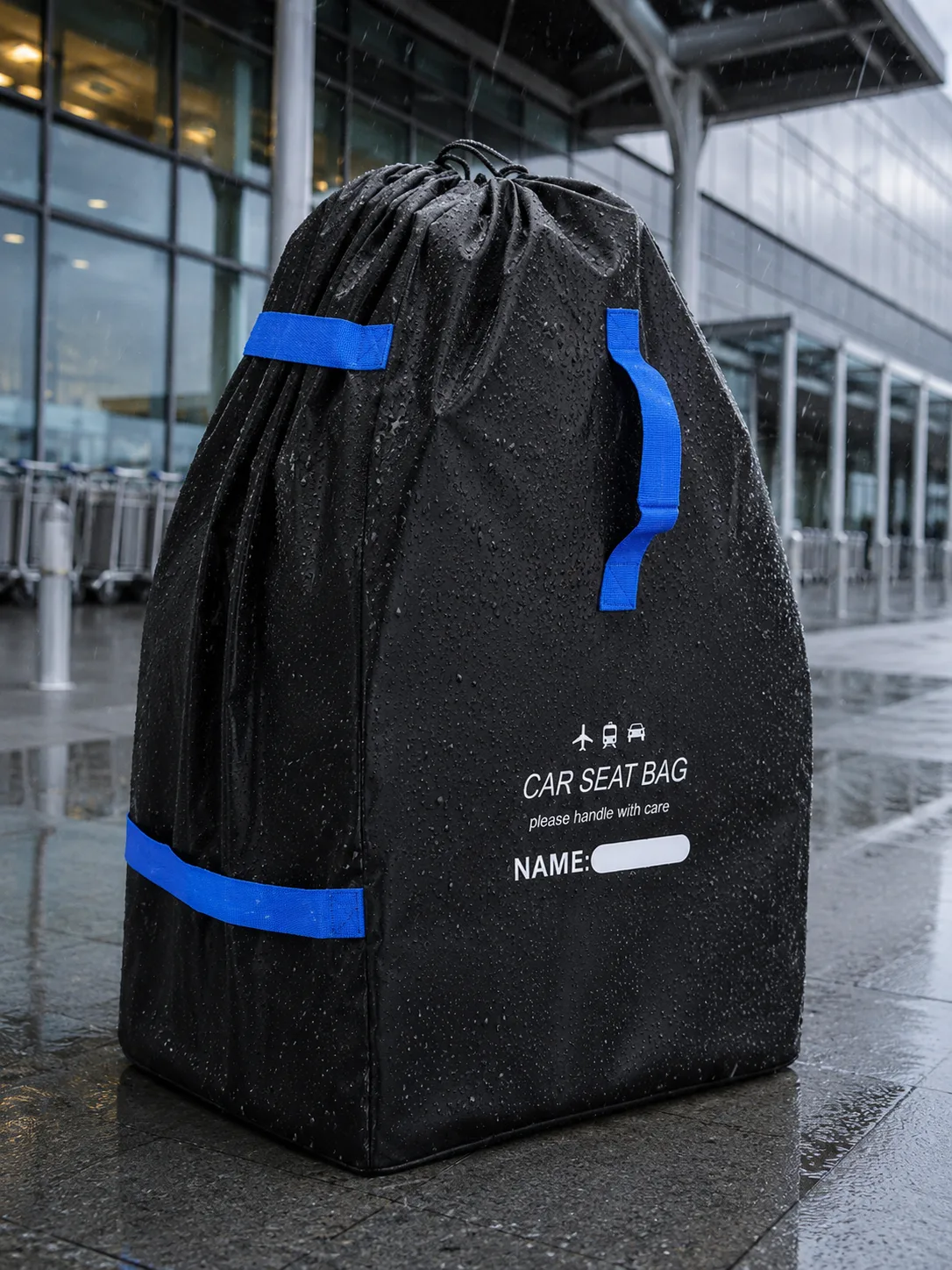
The moment carrying it stops being worth it
Carrying the seat further earns you nothing at the till. The airline takes it at the counter and at the gate on the same terms.
fee to check a car seat on major US airlines, counter or gate
— American, Delta, and United policies, 2026
checked bags mishandled per 1,000 passengers worldwide
— SITA Baggage IT Insights, 2023
typical list price of a convertible car seat
— manufacturer list prices, 2026
What the walk buys you is real: the seat stays with you until boarding, fewer hands touch it, and a tired child has somewhere familiar to sit through a delay. On a two hour layover with a toddler, that is worth a sore shoulder.
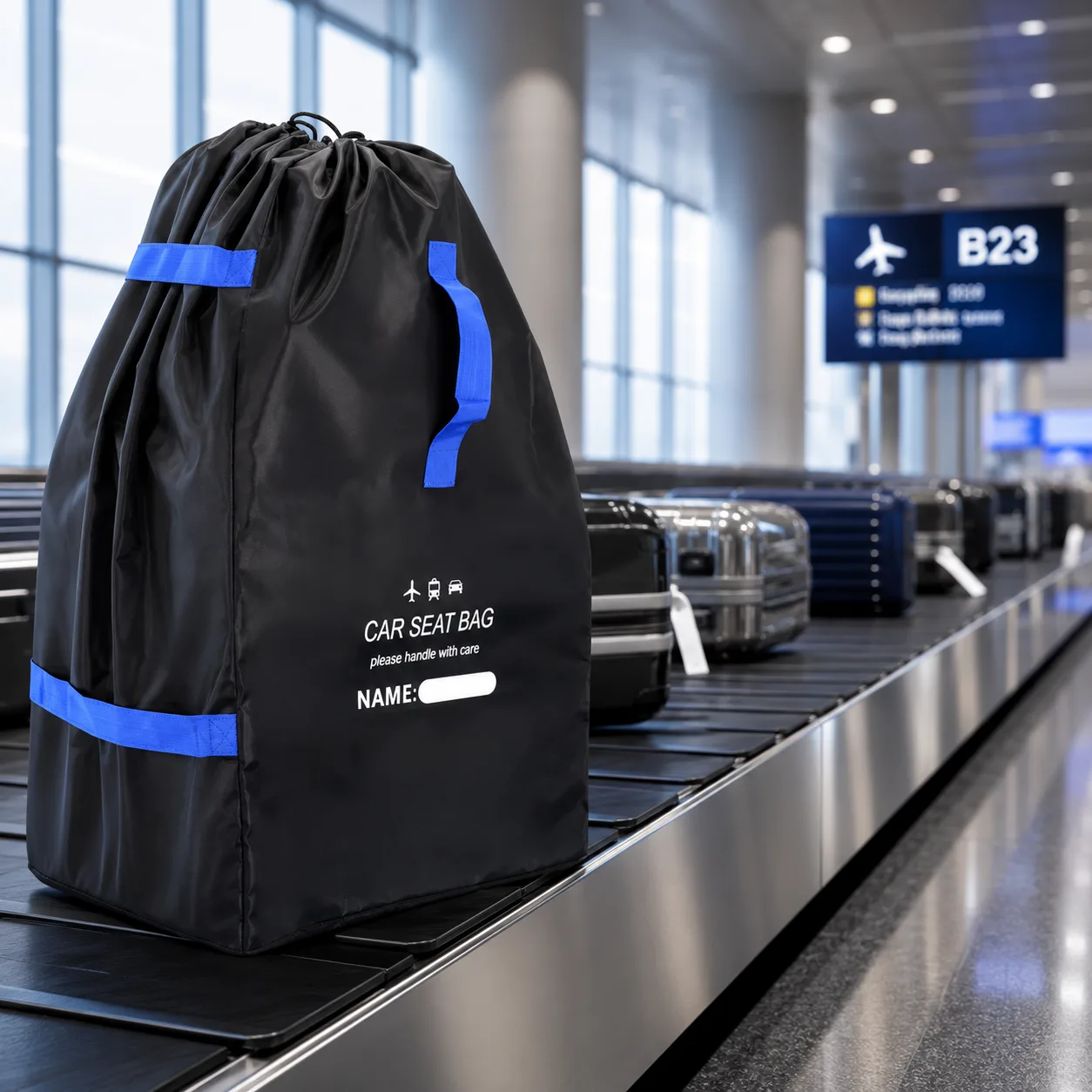
My rule after sixty flights: if you are outnumbered by children, or the connection is under an hour in a hub you have never walked, hand the seat over at the counter and take the free hands. The bag matters more then, not less: a counter-checked seat rides the full conveyor network instead of a short trip from the jet bridge. The three ways to fly a seat sit side by side in flying with a car seat.
Connections, terminal trains, and the walk nobody plans for
Direct flights hide how much of this is a distance problem. Connections do not. A tram between concourses, a gate reassigned while you ate, a bus to a remote stand: each one adds a carry you did not budget for, always on the leg where everyone is already tired.
International arrivals have their own trap. On many itineraries you clear immigration, collect your bags, recheck them and pass security again before the onward flight. A seat you gate checked comes back to you in the middle of that, so you carry it through the whole sequence instead of handing it over once.
This is where a bag that disappears earns its place. Our car seat travel bag folds into a built-in zip pouch, so between legs it lives in a diaper bag rather than the pile. A verified buyer from Israel put it in one line: "Just as described. Folds into a small bag when not in use. Large size, Joie Elevate R129 fits comfortably."
Carrying it out on the other end
The arrival carry has the least patience left in it, and it is often longer than the departure one. Rental car centers sit at the end of a shuttle or a train, hotel pickups at the far curb, taxi ranks one more escalator away.
Where the seat comes back depends on the airline and the airport, jet bridge or baggage claim, and asking a flight attendant before landing is the whole trick. The reclaim procedure is step by step in how to gate check a car seat. Either way, put the straps back on your shoulders for the last stretch.
One thing before you install it in a rental car: look the shell over. If you find a crack, a deformation, or anything you did not put there, ask the seat's manufacturer what to do before your child rides in it again. That call is theirs.
Questions parents ask about carrying a car seat through the airport
Can I push my child through the airport in the car seat?
Not with a travel bag. A bagged seat is a carried object: straps and a handle, no wheels. Purpose-built car seat carts and stroller frames do let a child ride, and we work through that trade-off on our car seat backpack page.
Does the car seat go through the X-ray at security?
Yes, much like a stroller. Send the bare seat along the belt and keep the travel bag folded until the gate. Seats too large for the belt get a hand inspection instead. TSA guidance for travelers with children is the authority, and the officer on duty makes the call.
Is it easier to carry the seat to the gate or check it at the counter?
It depends on how many hands you have. Carry it when an adult can wear it and your child still naps in it at the gate. Hand it over at the counter when you are outnumbered or facing a long walk, since checking a car seat is free either way on the majors.
Can I carry the car seat and push a stroller at the same time?
That is the standard family setup: bagged seat on one adult's back, stroller pushed to the boarding door and gate checked there. The stroller needs its own bag, since a folded stroller is long and flat while a car seat is boxy.
Flying with a stroller too? The routine is in the stroller gate check guide, and the stroller travel bag is a separate one-size cut with green straps.

Dana Whitfield · Family Travel Writer
Mom of two, 60+ flights with car seats in tow.